

To lower cost per lead on Meta Ads, improve the whole acquisition journey rather than targeting the cheapest form submission. Check tracking, clarify your offer, test distinct creative messages, and remove friction from the inquiry process. Measure contactable and qualified leads alongside reported CPL so lower acquisition costs reflect real business opportunities.
Trying to lower cost per lead on Meta Ads can backfire when teams focus on the cheapest submissions instead of real sales opportunities. A campaign may report an attractive CPL while sales agents receive irrelevant contacts, incorrect details, or people who do not remember inquiring. The problem may sit in the offer, tracking, form, creative, or follow-up process.
This guide is for businesses using Meta to generate appointments, service inquiries, or potential customers. It explains how to audit the complete journey, decide what a useful lead looks like, and run creative tests that support commercial results. The examples are illustrative, not claims about any Markti client. The approach is especially relevant when marketing and sales work in separate tools and need a shared definition of success.
What does a lower cost per lead actually mean?
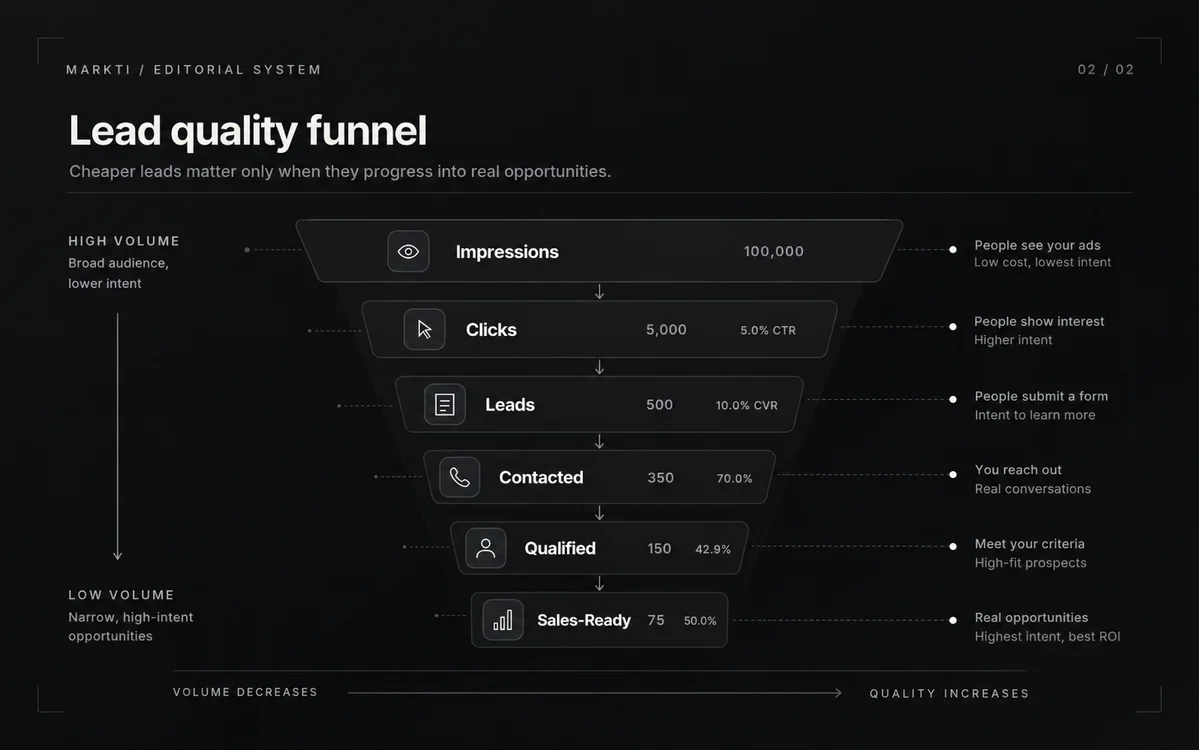
Cost per lead (CPL) divides advertising spend by the number of leads recorded. A cheaper CPL sounds attractive, but it says nothing about whether the people will answer, qualify, book, or buy. On Meta Ads, two campaigns can report the same number of form submissions and still create very different sales opportunities.
Define a lead that is useful to the sales team. A clinic may care about inquiries from people interested in an eligible service. A business-to-business supplier may need the company type, market, and purchase timing. An online store may measure purchases rather than forms. The definition should come from the business model, not from whichever platform event is easiest to optimize.
Illustrative example: One campaign delivers 100 leads at $5 each, while another delivers 40 at $10 each. If only five from the first campaign are qualified but twenty from the second are qualified, the second campaign produces a lower cost per qualified lead. The numbers are hypothetical and are not a client result.
Build a simple quality score with the sales manager. It might include contact validity, service fit, buying intent, and whether a conversation happened. Review quality consistently before changing the campaign budget.
How do you audit tracking before changing your ads?
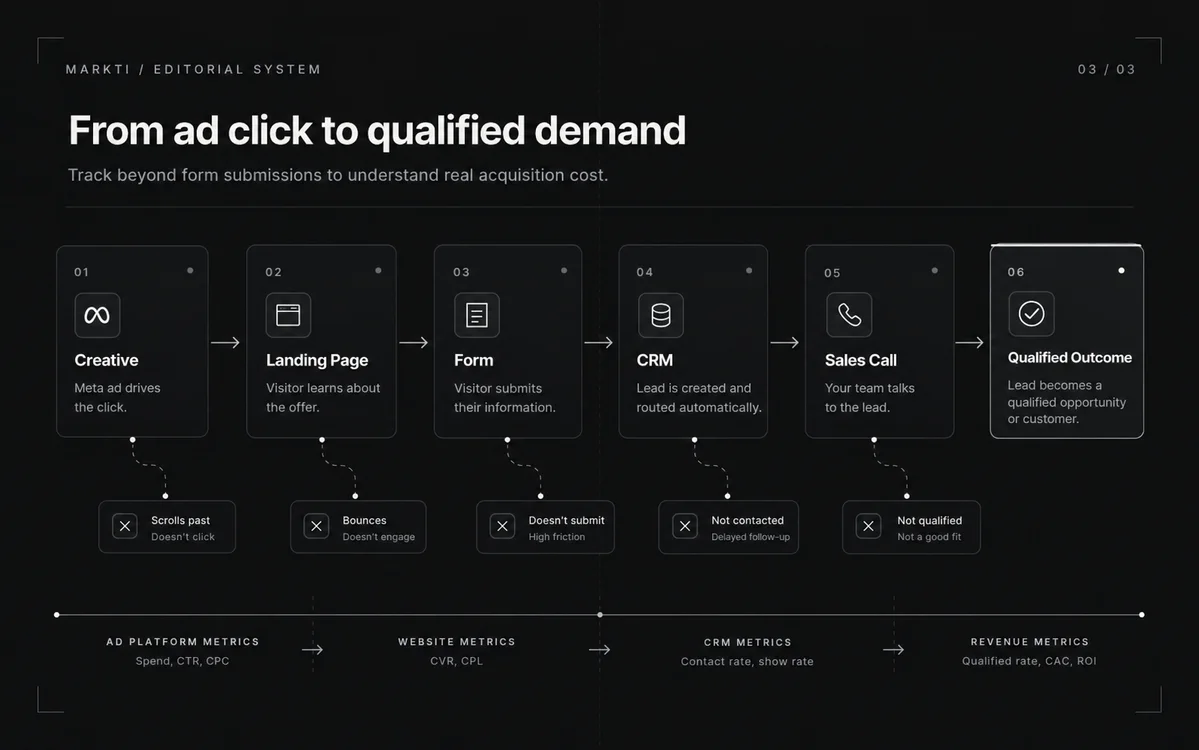
Start by confirming what each reported conversion means. Is it an instant form submitted on Meta, a website form completion, a purchase event, or a qualified lead imported from a CRM? These actions are not interchangeable. Review the campaign objective and whether the primary event reflects what you actually want.
Check that a form submission counts once, that test leads are excluded when appropriate, and that the campaign’s date range matches the sales team’s follow-up period. A visitor can click an ad today and buy later. A report that ends too early may make the campaign look weaker than it is.
Practical checklist: Open the event setup; make one controlled test submission; inspect the resulting event; confirm the lead is recorded in the CRM; and check that the same lead does not appear as two people. For websites, review consent requirements and make sure the team handles personal data appropriately.
Google’s conversion measurement guidance makes the same broad point: valuable actions must be defined before reporting can guide spending. Apply the principle across platforms without assuming their attribution systems report identical results.
Only after measurement is credible should you compare creative, audience, placement, and offer changes. Otherwise you may optimize around a tracking mistake.
Which campaign elements usually affect lead cost?
The offer
A vague offer leaves people guessing. Replace broad phrases with a precise service, audience, and next step. For example, a travel operator can explain the trip category and what an inquiry includes rather than using a generic “contact us” message.
The creative
The opening message should speak to a customer need, not simply decorate the ad. Test distinct reasons to choose the service: convenience, expertise, product quality, selection, or a practical advantage. Use clear visuals and mobile-readable text.
The destination
An ad promises one thing and the landing page must deliver it. Align the offer, imagery, and headline. Ask only for the information needed to take the next step. An extra field may deter some users, but removing every field can also reduce useful qualification. Test the tradeoff.
The follow-up
Advertising does not end at submission. If a lead waits too long or receives a confusing response, paid traffic is wasted regardless of the original CPL. Make sure inquiries reach a responsible person, that contact history is visible, and that sales feedback comes back to the marketing team.
Work on one major issue at a time. Testing a new creative, landing page, and offer simultaneously can make it impossible to know what caused the result.
Should you use instant forms or a landing page?
Instant forms can reduce friction because people submit within the platform. A landing page gives you more control over the explanation, evidence, and qualifications presented before someone contacts you. Neither is automatically the best option. Choose based on the decision the customer needs to make.
For an uncomplicated local inquiry, a short form may be sufficient. For a high-consideration service, such as medical tourism, financial education, or a specialized B2B quote, a landing page may provide essential details and trust signals. A clear page can also answer common questions before a sales representative becomes involved.
Compare the full journey rather than the form submission rate alone. Track the percentage of leads that can be contacted, fit the offer, and progress to a useful conversation. If a landing page costs more per submission but produces a larger share of qualified inquiries, it may be the better investment.
Make the response expectation visible. Tell people what happens after they submit, whether a team will call or email, and what information to prepare. Use language and formats appropriate to the audience. On mobile, check page speed, font sizes, form fields, and tap targets before sending more traffic.
A short monthly review with the sales team should answer two questions: where does the funnel lose suitable prospects, and where does it attract unsuitable ones?
How do you test creative without wasting budget?
Creative testing should begin with a written hypothesis. “A clearer explanation of the service will improve qualified inquiries” is useful because the test has a purpose. “Try something more exciting” is not. Keep the customer group and conversion event as comparable as practical so the results are easier to interpret.
Use three genuinely different message angles rather than three near-identical colors. One may explain the problem, one may demonstrate the product or experience, and one may answer an objection. Match each variation with relevant visuals and the same next step. Make sure claims remain accurate and comply with the category’s advertising rules.
Do not judge an ad only after a few clicks. Evaluate whether the test has enough meaningful activity and whether delivery conditions were stable. Platform learning, seasonal demand, budget changes, and creative fatigue can all influence short-term results.
Document the result in a test log: date, audience, offer, creative concept, conversion event, budget, and observed lead quality. Keep the finding even when a variation performs worse. The goal is to build a stronger understanding of the customer’s response, not simply accumulate assets.
If an ad attracts many cheap but irrelevant submissions, consider making the message more specific. Lower volume can be worthwhile if the share of suitable leads improves.
A cheap lead that never becomes a useful conversation is expensive.
How do you measure whether lead acquisition is improving?
Create a funnel report that marketing and sales both understand. Start with impressions, clicks, form submissions, contacted leads, qualified conversations, and completed sales or appointments. Use consistent definitions and compare the same stage from period to period.
For each campaign, review at least four figures: cost per recorded lead, percentage contacted, cost per qualified lead, and progression to a commercial outcome. A smaller campaign can be more valuable than a larger one if it supports a healthier pipeline.
Illustrative calculation: If $600 produces 60 form submissions, CPL is $10. If 15 of those leads qualify, cost per qualified lead is $40. These are hypothetical numbers provided only to explain the calculation. They are not typical benchmarks or a performance promise.
Investigate changes in the data before reacting. A new sales script, an offer change, phone-number deliverability, or duplicated submissions can change apparent quality without any meaningful change in ad targeting. Talk to the team receiving the inquiries.
At the end of the review, choose one decision: improve the message, repair tracking, test the conversion journey, adjust follow-up, or reallocate spend. Avoid making all those changes at once. Clarity in the next action is the real purpose of reporting.
Frequently asked questions
What is a good cost per lead on Meta Ads?
There is no universal number. A useful target depends on margins, customer value, conversion rate, sales capacity, and market competition. Calculate the maximum affordable cost per qualified opportunity rather than copying a benchmark from another industry.
Will a higher-intent form always reduce low-quality leads?
Extra questions or confirmation steps may filter some casual submissions, but they can also reduce overall volume. The effect depends on the audience, offer, and user experience. Compare contactability and qualification rate, not just the submission count.
How often should I change my Meta campaigns?
Review performance routinely, but avoid frequent changes based on very small samples. Use a documented test plan, allow campaigns time to generate meaningful data, and distinguish delivery fluctuations from a real shift in lead quality.
Is a landing page better than Meta instant forms?
A landing page provides more room for explanation and proof; an instant form may reduce friction. Test each against the same downstream sales measures. The right choice depends on how much information a customer needs before contacting you.
Next steps for your campaigns
Define a qualified lead with your sales team, check event tracking, review the offer and form, and select one creative hypothesis to test. Keep a written record of what changed and measure outcomes after the form. This makes it easier to spend with purpose rather than chasing the lowest dashboard number.
- Optimize for qualified conversations, not just submissions.
- Confirm conversion tracking and CRM feedback.
- Match advertising messages with the landing experience.
- Review sales progression before reallocating budget.
Related: conversion-focused websites and advertising budget planning.