

A small business should set its advertising budget from its margins, customer value, conversion rate, and available cash, not a universal percentage or daily spend rule. Separate platform spend from creative, website, tracking, and management costs. Run a controlled test, measure qualified customers or sales, and increase spending only when the economics justify it.
Choosing a small business advertising budget feels difficult because most advice starts with a number. Spend a percentage of sales. Set a daily limit. Copy what competitors do. None of these rules accounts for whether the business earns enough on each customer to make the spending sensible.
The better approach starts with your commercial reality. A retail brand, local clinic, travel agency, and specialized supplier have different margins, buying cycles, and conversion journeys. This guide shows you how to calculate an affordable acquisition cost, identify the real cost of advertising, choose a useful test, and decide when to scale. You will see illustrative calculations, but no invented performance benchmarks or guarantees. The aim is to make advertising a controlled investment instead of an expense driven by guesswork.
How much should a small business spend on advertising?
A practical small business advertising budget starts with the money a new customer contributes to the business. A business with repeat purchasing and strong margins may be able to afford a higher acquisition cost than one making a single low-margin sale. That difference matters more than a generic recommendation to spend a fixed percentage of revenue.
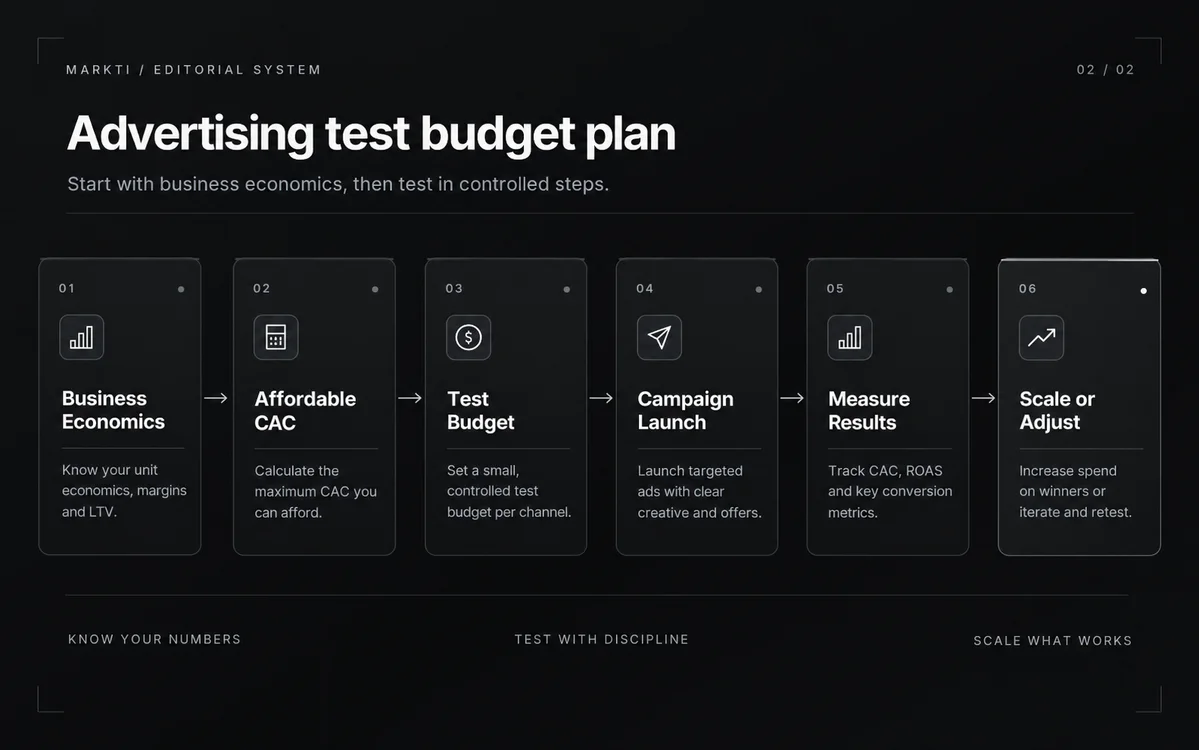
Start by listing your average sale, gross margin, repeat purchase expectations, and the costs required to deliver the product or service. Estimate the maximum amount you can afford to pay for a new customer without making the sale unprofitable. If cash is tight, preserve the funds you need for operations, payroll, and fulfillment before committing to tests.
Illustrative example: A product sells for $100 and has $45 in gross margin before acquisition and overhead. Paying $50 to acquire that customer may be unsustainable without repeat purchases or other value. This is an example of the calculation, not a recommended cost target.
Businesses that sell high-consideration services need another step. Estimate the percentage of inquiries that become customers. Your maximum affordable cost per lead is lower than your maximum cost per customer because not every lead will convert.
Build the budget around realistic unit economics. Do not commit spend simply because a competitor appears to advertise heavily.
What costs belong in the advertising budget?
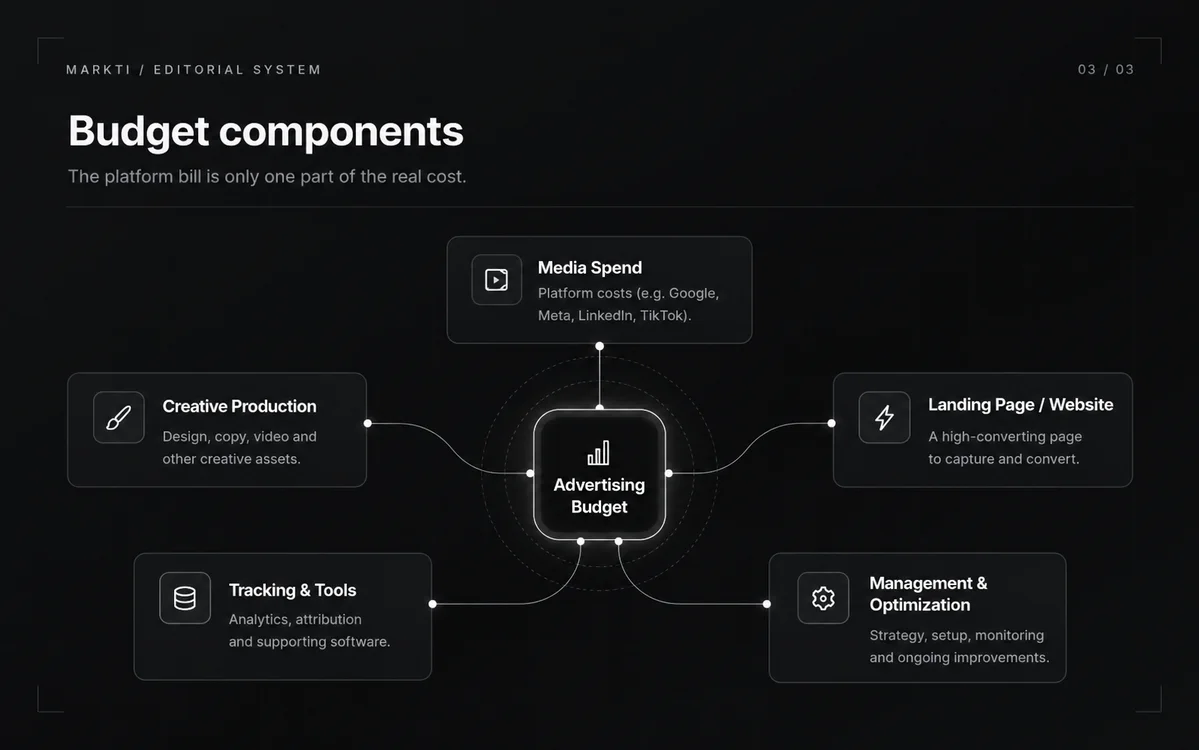
Separate the media budget from everything required to make that media useful. Platforms receive money to display advertising. A business also spends on creative production, product photography, copy, website changes, measurement, and campaign management. Treating only the platform invoice as the advertising cost hides important parts of the investment.
Build a simple monthly budget sheet with four sections: platform spend, asset production, tracking and tools, and management time or fees. Put expected and actual costs in separate columns. If you cannot estimate a cost yet, mark it as unknown instead of pretending it is zero.
Example: An e-commerce store may spend on Meta campaigns and also require product photos, new landing-page copy, creative adaptations, and feed maintenance. A professional service company may rely less on product photography but need more explanation and trust signals on its website.
Before paying for several platforms, confirm that the current website can convert relevant visits. Check page clarity, mobile usability, form completion, product availability, and how quickly the team answers inquiries. A large media budget sent to a confusing page often creates more waste than growth.
Separate one-time setup costs from recurring costs. An initial tracking repair should not be confused with an ongoing media management fee. This makes future decisions and supplier comparisons more transparent.
How can you calculate an affordable acquisition cost?
Start with the value of the first purchase or contract. Subtract the direct costs required to deliver it, then account for other expenses and the profit you want to keep. The amount available for acquisition must fit within what remains. If you expect repeat purchases, use a realistic estimate supported by existing customer data rather than assuming every buyer will return.
Next, connect the customer target to the lead funnel. Suppose a local service business closes one out of five qualified consultations. The maximum cost per qualified consultation should reflect the fact that several consultations may be needed for one customer. If the close rate is uncertain, use a conservative assumption and revisit the budget once you have reliable records.
Illustrative calculation: If you can afford $100 to acquire a customer, and 20% of qualified leads become customers, the break-even cost per qualified lead before other acquisition costs is $20. Actual budgeting may require a lower target to preserve profit. These values demonstrate the relationship, not typical market performance.
For e-commerce, the advertising platform may report return on ad spend (ROAS). Revenue divided by ad spend is not net profit. Consider product margin, shipping, returns, creative production, and attribution limits before deciding a ROAS figure is sustainable.
Write the assumptions clearly and review them with finance or the owner. A marketing plan without this step can appear successful in campaign reports while the business loses money.
How do you choose a sensible starting test budget?
A test budget should be large enough to produce useful observations without risking essential cash. The exact amount depends on market competition, the type of conversion you track, the price of the offer, and the number of creative variations you need to evaluate. A universal daily number will not work for all businesses.
Choose one primary goal: purchases, qualified leads, consultation inquiries, or another action tied to the business. Select one market, one strong offer, and a limited set of creative concepts. Record the hypothesis for each variation and avoid spreading a small budget across too many platforms and audiences.
Example: A home-decor seller may first test two product collections and three distinct messages, directing traffic to pages with correct sizes, prices, and delivery details. A specialist B2B company may test one clear service page with a qualification form rather than launching broad awareness campaigns.
Set a maximum test spend before launching. Decide how you will judge whether the information is useful: Are people interacting with the right product? Are leads contactable? Do inquiries progress to sales? Agree on the review point so pressure to continue spending does not replace evidence.
Give the campaign enough time to collect meaningful activity, while checking for obvious technical problems immediately. If tracking is broken or an offer is unavailable, pause and repair it rather than waiting for a statistical conclusion.
Should you use Meta Ads, Google Ads, or another channel?
Channel choice should follow customer intent. Search advertising can be useful when people already know what they need and actively look for a solution. Social advertising can help introduce products or offers to relevant audiences who were not searching for them at that moment. Both need a clear message and a conversion journey.
For a local emergency service, search intent may be more valuable than broad creative discovery. For a new lifestyle product, visual storytelling and product demonstrations may help people recognize the offer. For a professional service, useful educational content and a credible landing page may support a longer decision cycle.
Consider how each platform reports conversions. Google Ads offers conversion measurement for actions businesses define as valuable, such as purchases and inquiries. See Google’s conversion measurement documentation. On any platform, check that the event being optimized matches a meaningful outcome.
Do not assume that launching on more channels always creates more growth. Each additional platform adds management, creative, measurement, and learning work. Start with a focused mix you can maintain, then expand when existing activity produces reliable evidence.
Keep some budget flexibility for the website and sales process. If the campaign reveals a serious conversion issue, fixing the page may be more valuable than buying more traffic.
An advertising budget is sensible only when the business can afford the customers it brings.
When should you increase, reduce, or stop spending?
Increase spend gradually when measurement is reliable, the sales team can handle demand, and customer economics support additional acquisitions. Check whether the stronger result holds across more than one reporting period. Short-lived improvements may be caused by temporary promotions or unusual demand.
Reduce or pause spending when lead quality deteriorates, tracking breaks, the business cannot serve new customers, or acquisition costs exceed what margins can support. The purpose of a budget is to manage risk as well as opportunities. Stopping an unproductive test is a useful decision, not a failure.
Use a weekly operating review. Record spending, qualified opportunities, sales or bookings, and any operational issue that influenced results. Use monthly reviews for larger allocation decisions and for assessing whether the marketing investment fits the wider business.
Illustrative example: If clicks rise but purchases stay flat, inspect the landing page, product availability, and measurement before assuming the targeting is wrong. If form submissions rise but the contact rate drops, review the form and follow-up process. If qualified conversions improve while media cost stays stable, you have stronger evidence to consider increasing spend.
Every adjustment should have a reason, an owner, and a follow-up date. That discipline gives a small business more control than copying a spending rule that ignores how the company actually earns money.
Frequently asked questions
What is the minimum monthly ad budget for a small business?
There is no universal minimum that works across industries. Start with your affordable acquisition cost, market competition, and whether a test can produce meaningful observations. A smaller focused test can be more responsible than funding multiple channels without sufficient measurement.
Should a new business spend money on ads or SEO first?
The answer depends on how customers find the offer and when results are needed. Advertising may generate quicker test data while SEO and useful content build a longer-term discovery foundation. Your website, positioning, and conversion tracking should support either choice.
Does a high ROAS mean the business is profitable?
Not necessarily. ROAS compares attributed advertising revenue with advertising spend; it does not automatically include product margin, delivery costs, returns, agency fees, or every customer interaction. Review contribution margin and attribution quality before declaring a campaign profitable.
How do I know when to scale advertising?
Scale when you can track relevant conversions, serve the additional demand, and acquire customers within sustainable economics. Make changes deliberately, document what changed, and review whether lead quality and margin remain healthy as spending increases.
Your next budgeting decision
Calculate customer contribution, set an affordable acquisition target, and list the complete cost of producing and measuring advertising. Start with a focused goal and clear review criteria. Adjust the plan based on qualified sales opportunities, not just impressions or clicks.
- Protect essential operating cash before committing spend.
- Track both media costs and production expenses.
- Use business economics to evaluate acquisition results.
- Expand channels only when existing measurement is reliable.
Related reading: lowering Meta Ads lead cost and conversion-focused websites.