
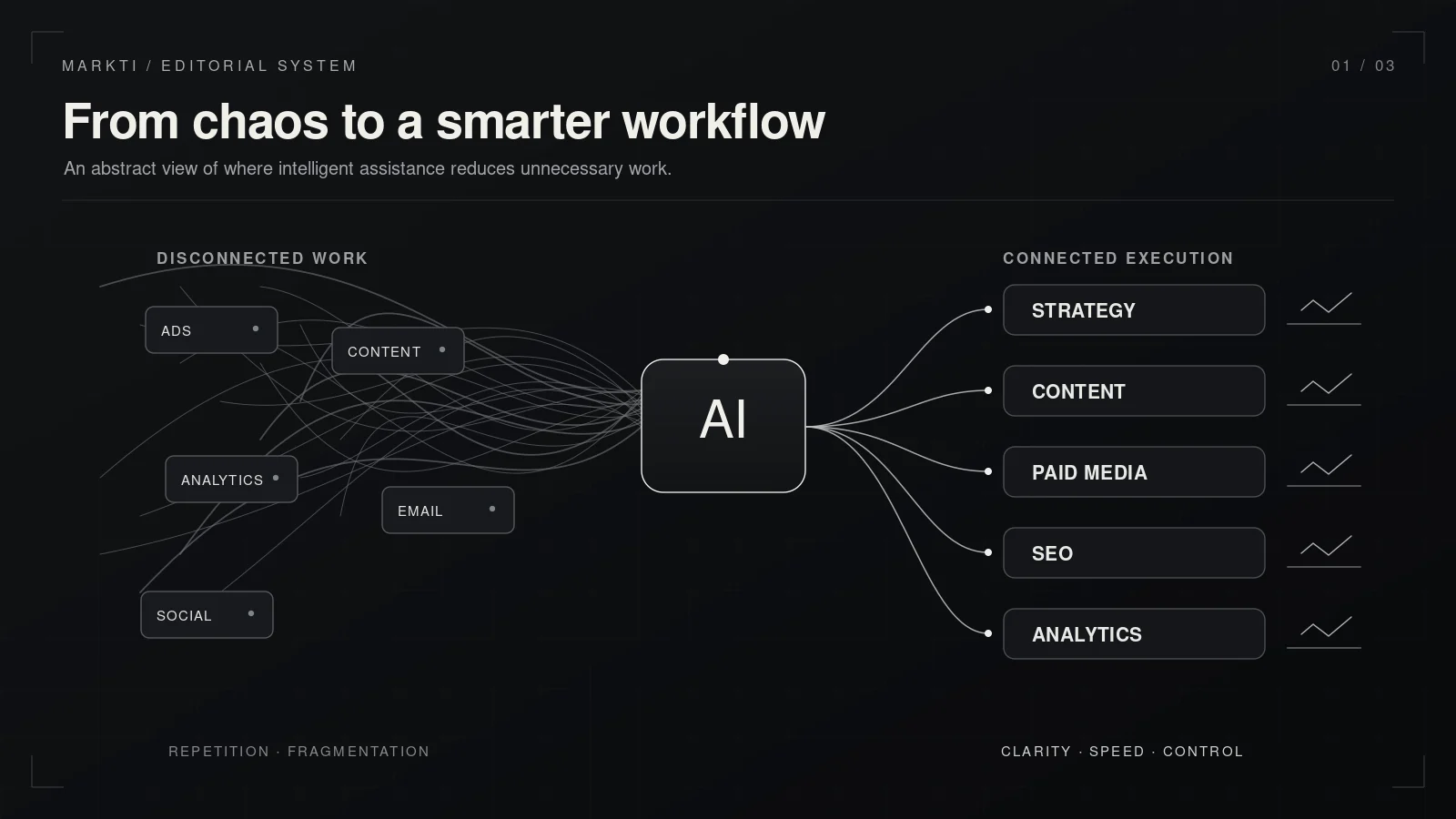
AI cuts marketing costs by speeding up repetitive work such as research, first drafts, creative variations, and reporting. Real savings come from fewer production hours and faster learning, not automatic performance gains. Humans still need to own strategy, factual accuracy, brand voice, sensitive claims, and final approval.
AI marketing costs are easiest to understand when you look at how much time and money it takes to produce a useful outcome. Many teams pay for repeated research, formatting, first drafts, translations, and reports. These tasks matter, but they are not all equally valuable. Faster output can reduce overhead, provided it does not create more corrections or weaken the finished work.
This guide shows how to identify the tasks worth assisting, where a human must remain in control, and which numbers can demonstrate actual savings. It is a framework for marketing teams and growing businesses, not a promise of a specific percentage reduction. The goal is to produce work that is accurate, recognizably yours, and commercially useful with less unnecessary effort.
Where does your marketing budget actually go?
Before trying to reduce AI marketing costs, separate the money you pay to reach customers from the money you pay to produce and manage the work. These are different problems. Media spend buys advertising opportunities. Production costs cover research, copy, designs, translation, landing pages, and reporting. Your team’s hours are a cost even when no invoice mentions them.
Write down what you spend on each activity over one ordinary month. Include staff time, freelance fees, software subscriptions, review rounds, and the hours spent copying information between tools. Do not forget rework: fixing an unclear brief or recreating assets for a different format often costs more than the first draft.
Example: A retail business may produce social posts, product ads, email content, and weekly campaign reports. If each output requires fresh research and repeated formatting, much of the effort is operational rather than strategic. Those repeatable stages are candidates for assistance.
Separate the work into three columns: work that needs expert decisions, work that benefits from structured first drafts, and mechanical work that can be automated safely. Start with time tracking rather than an assumed savings percentage. It gives you a baseline for seeing whether a new process actually helps.
Which six marketing tasks can AI speed up?
1. Research and competitor mapping
AI can organize a list of customer questions, categorize competitor messages, and turn interview notes into themes. Give it approved sources and ask it to show where every claim came from. An analyst should validate the underlying evidence, especially when the market is unfamiliar.
2. First drafts of marketing copy
Use a positioning document to produce possible headlines, product descriptions, and email outlines. A good prompt includes the target customer, the offer, prohibited claims, and examples of your brand voice. Keep the final writing with an editor who understands the business.
3. Creative variations
A creative team can test several angles without rebuilding a new brief each time. Generate concept lists, formats, and hook alternatives. Designers still select, adapt, and approve the work. More alternatives have value only when they answer a real testing question.
4. Translation and localization
AI can provide draft adaptations for English, Arabic, and other languages. Do not treat translation as localization: a person familiar with the intended market should check tone, references, and sensitive claims.
5. SEO planning
Organize keyword themes, classify search intent, and produce article outlines. Editors must confirm that each planned page answers a useful question and does not simply repeat existing content.
6. Reporting
Turn verified campaign tables into a readable first summary. Provide the actual figures, clear definitions, and reporting period. A marketer should confirm anomalies and decide what the numbers mean before sharing conclusions.
Where should AI not make the decision?
AI produces convincing language, but confidence is not evidence. The most expensive marketing mistakes often come from the decisions behind the creative, not the act of writing it. Positioning a brand, choosing a business objective, interpreting weak tracking, and making an offer all require context the system may not have.
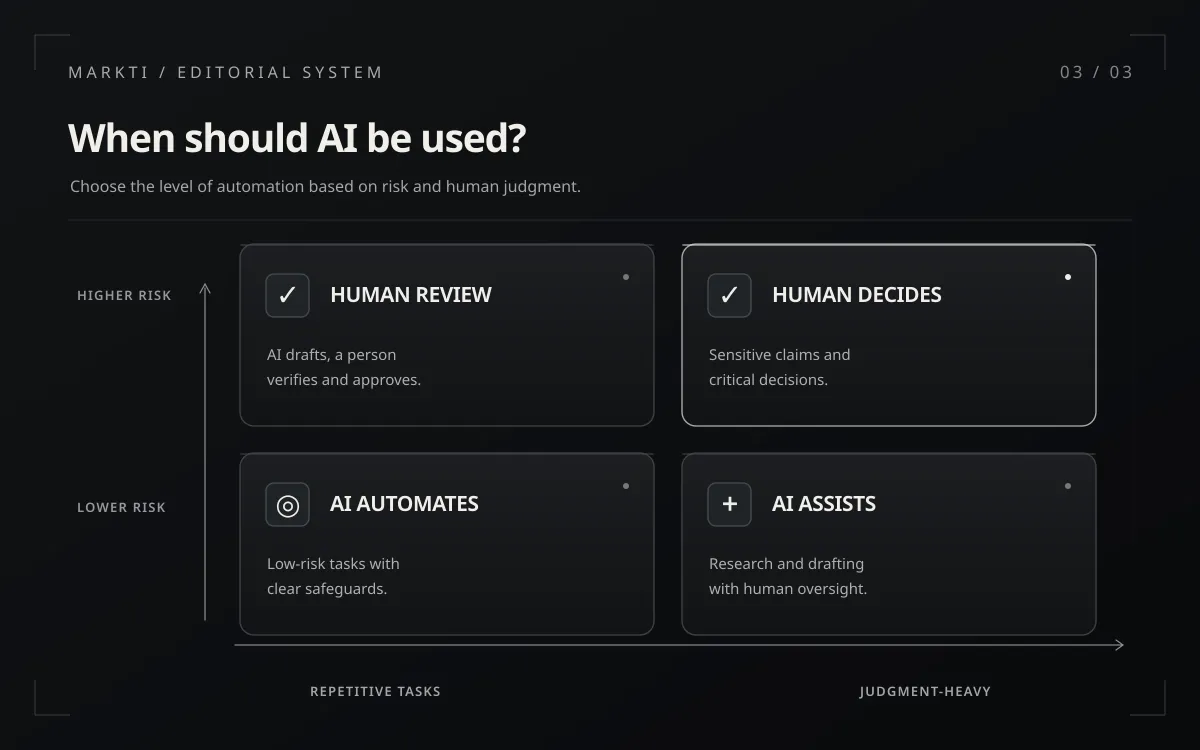
Keep final authority with a responsible person when work touches financial claims, healthcare, customer privacy, legal restrictions, public statements, or significant ad budgets. A model should not approve a claim that a clinic guarantees results or that a trading product offers assured returns. In these categories, approval may also require a qualified compliance reviewer.
Use a simple decision rule: if a mistake is cheap, reversible, and easy to detect, assisted automation may be suitable. If an error could mislead customers, waste significant budget, or expose personal data, require human review before publication or execution.
Protect data as carefully as output quality. Remove customer identifiers from research examples and check whether a tool’s data handling fits your obligations. Do not paste client lists, confidential contracts, or raw patient information into tools without an approved process.
AI works best as a production assistant with defined boundaries. Assign an owner to every deliverable, and make the approval step visible instead of assuming that a polished draft is ready to publish.
How do you maintain quality while using AI?
Begin with a brand brief. Include the audience, differentiators, terminology, tone, examples of strong existing work, and claims that cannot be made. A generic prompt invites generic output. Good inputs do not guarantee good results, but they make review faster and more consistent.
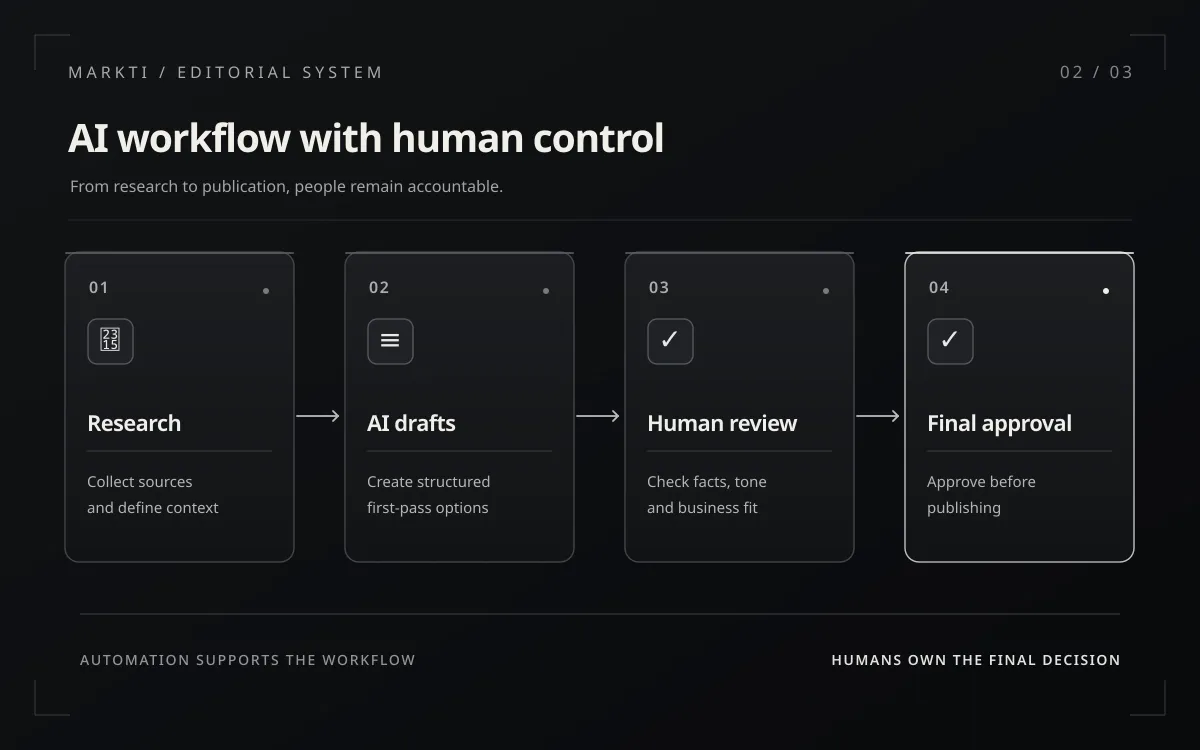
Use a two-pass editing process. In the first pass, an expert reviews the substance: Is the recommendation appropriate? Can we support the facts? Does the offer reflect the business? In the second pass, an editor improves the language, visuals, structure, accessibility, and links. If the draft fails the first pass, polishing its wording is wasted effort.
Example: An e-commerce agency may draft ten ad headlines from a product brief. The brand manager removes unsupported urgency and confusing promises. A designer pairs the strongest concepts with real product assets. Only approved variations go into a controlled test.
Quality also depends on having one source of truth. Maintain an approved offer sheet, product specifications, campaign naming rules, and a shared glossary. When those inputs change, update the prompt materials before generating new drafts.
Read the result as your customer would. If it offers no useful answer, contains repeated phrases, or sounds unlike your brand, it is not ready. Google also emphasizes useful, reliable, people-first content rather than content created primarily to manipulate rankings. Read Google’s quality guidance.
AI should remove hours, not judgment.
What practical AI marketing workflow can you copy?
You do not need a complicated stack to begin. Choose one repeated activity, such as a weekly campaign report or a set of creative variations. Document the existing steps, what each person needs, and where mistakes happen. Then introduce assistance only at the stages that have a clear purpose.
- Brief: state the business goal, audience, offer, inputs, limits, and owner.
- Research: collect approved information and let AI organize patterns or questions.
- Strategy: a marketer chooses the direction, channels, and success measure.
- Draft: AI assists with copy, outlines, formats, or first summaries.
- Edit: a person checks facts, brand voice, claims, and execution quality.
- Launch: approved assets and measurement go live.
- Report: tools summarize verified performance and flag unusual changes.
- Decide: a responsible manager chooses the next test or adjustment.
Record where the human checkpoints sit. If work moves between tools, use consistent labels so the team can trace which brief produced which asset and which version went live.
Do not automatically scale the process after one successful output. Run several cycles, compare the quality of drafts, and check whether reviewers really spend less time overall. A system that produces twice as many drafts but triples approval work is not more efficient.
How do you measure real marketing savings?
Choose a baseline before making a change. Measure hours per approved deliverable, the time from brief to launch, the number of useful tests completed, and the rate of revisions. For acquisition work, track cost per qualified lead or sale rather than just cost per click. These measures describe different outcomes and should not be blended into one score.
Example calculation, illustrative: If a report used to take four hours and now takes two hours including review, the workflow has saved two hours on that report. You still need to account for software costs and the time needed to maintain the process. That is a labor calculation, not proof of increased ad performance.
Compare equal time periods with similar workload. A seasonal sales peak, an offer change, or tracking repairs can change marketing results even when production is unchanged. Make a note of external factors so the improvement is not attributed to the wrong cause.
Review four numbers every month: production hours, revision hours, time to launch, and the qualified commercial outcome. Document what changed and whether the change should stay. When you can show lower work costs without a drop in quality or business results, you have evidence that the new workflow is useful.
Frequently asked questions
Does AI-generated marketing content hurt SEO?
Not automatically. Search performance depends on whether the final content helps readers, answers the query, and is accurate and trustworthy. Review AI drafts, add genuine expertise, and avoid publishing large numbers of thin pages simply to target keywords.
Is AI cheaper than hiring a marketing agency?
The comparison is incomplete. AI tools can assist with drafting and research, but they do not replace business strategy, reliable execution, compliance review, or accountability. Compare the full cost of tools, people, revisions, and results for your situation.
Which marketing tasks should never run without approval?
Keep a person in control of sensitive claims, major budget changes, customer data handling, public commitments, and final brand decisions. The higher the cost of an error, the more important explicit review becomes.
How fast can a business see savings?
Time savings can appear in the first repeated workflow, but meaningful financial savings require a baseline and several comparable cycles. Track production hours, edits, launch times, software costs, and lead quality before deciding whether to expand automation.
What to do next
Start with one repeatable task, measure the cost of doing it today, and define who will approve the result. Put AI where it can prepare useful work faster. Keep strategic choices, factual claims, and final quality checks with people.
- Separate media costs from production costs.
- Automate lower-risk, repetitive steps first.
- Record human review before publishing or spending.
- Measure hours saved alongside commercial outcomes.
Related services: AI marketing workflows and performance advertising.