

AI-written content is not inherently bad for SEO. The issue is the quality and purpose of the published page, not simply whether a tool helped draft it. Useful articles answer real questions, verify claims, add expertise and original value, and receive human editorial review. Mass-produced, repetitive pages made mainly to attract rankings create quality risks.
Is AI-written content bad for SEO? The question matters because many businesses now use AI for keyword research, article outlines, and first drafts. The tools can save time, but publishing fast does not automatically mean publishing well. A page can contain polished language and still fail to answer the reader’s real question.
This guide separates the method of producing text from the quality of the final page. You will learn how to use AI assistance responsibly, identify thin or misleading content, plan articles around useful search intent, and review pages before they go live. The goal is a sustainable editorial process that serves readers and supports your brand. None of the steps can guarantee search rankings, and any numerical example should be based on verifiable data or clearly labeled illustrative.
Does Google penalize AI-written content?
Using AI to help write a page is not automatically a reason for that page to perform poorly in search. Google’s published guidance focuses on whether information is helpful, reliable, and created for people rather than primarily to manipulate search rankings. Read its people-first content guidance before deciding how AI fits into an editorial workflow.
The risk appears when a business publishes a large volume of pages that add little useful information, make unsupported claims, or repeat material without original insight. A fluent article is not necessarily a valuable one. It may sound complete while omitting the practical detail a reader came to find.
Think about a local business publishing a guide to choosing a service. If the content merely rephrases the same generic definitions found on many other websites, it offers little reason for a visitor to trust that business. If it explains how to evaluate the service, what questions to ask, and which tradeoffs matter, it has a clearer purpose.
Ask whether a real customer would benefit from the page even without search traffic. If the answer is no, reconsider the topic and the content before publishing. Search optimization should make helpful material easier to discover, not justify creating pages with no useful audience.
What makes an AI-assisted article genuinely useful?
A good article starts with a real search question and gives a concrete answer. The reader should understand the issue, know what to do next, and recognize where a recommendation depends on their circumstances. That requires research, examples, editorial judgment, and a structure that respects the reader’s time.
Choose one primary search intent. Someone asking “how much should I spend on ads?” needs a budgeting method and relevant examples, not a long promotional explanation of every advertising platform. Someone asking whether AI content affects SEO needs a clear distinction between the writing tool and the quality of the published information.
Use AI to organize interview notes, plan sections, identify unanswered questions, and explore alternative explanations. Add actual subject expertise: details from work processes, common customer misunderstandings, the limitations of the advice, and an honest explanation of any assumptions.
Practical test: Highlight every paragraph that could appear unchanged on a competitor’s website. Rewrite or remove the passages that offer no distinctive value. Then ask someone unfamiliar with the draft to describe what actionable answer they learned. If they cannot, the content needs work.
Be careful with examples. An illustrative calculation should be identified as such, not presented as a client result or a market average. Readers deserve to know which numbers are observed and which exist only to explain a concept.
How do you research keywords without producing thin pages?
Keyword research should help you understand questions, not produce one nearly identical article for each variation. Start with the customer journey: discovery, comparison, evaluation, purchase, and follow-up. List the questions people ask at each stage and identify which ones the business can answer with useful expertise.
Group related terms by meaning. “AI-written content SEO,” “AI content and Google rankings,” and “is AI content bad for SEO” may represent one central question. Publishing three weak versions can make the site harder to navigate. A strong consolidated page with clear subheadings may serve the audience better.
Choose a primary keyword for the title, URL, first paragraph, and one relevant section heading when it fits naturally. Use related expressions where they add clarity, not as a checklist of phrases to repeat. Search engines and readers can understand normal language.
Map internal links before publishing. An article about paid advertising budget can link to a practical lead-cost guide and a relevant advertising service, but should not link to every service merely to add navigation. Each link should help readers continue the decision they are making.
Keep topic coverage organized by a few editorial pillars. Markti’s themes include paid acquisition, AI-assisted operations, brand strategy, SEO, website conversion, and related business systems. A clear structure makes future updates and navigation easier.
What should a human editor verify before publishing?
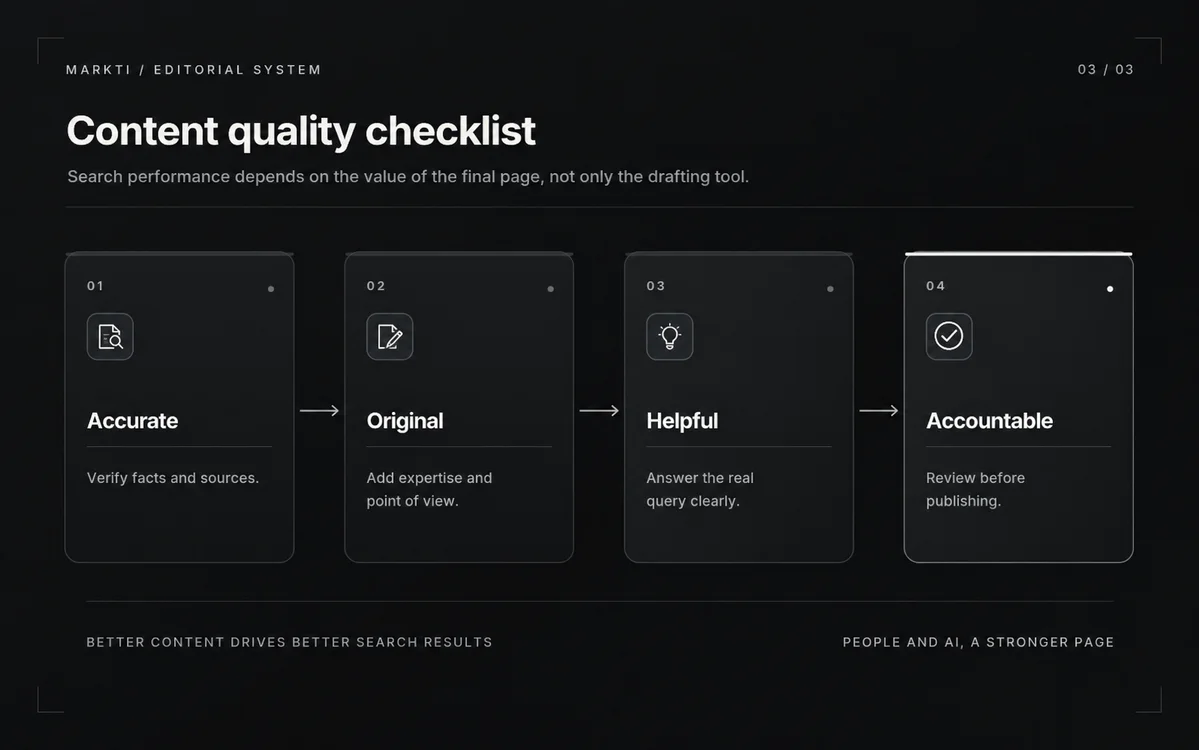
Fact checking is the first responsibility. Confirm numbers, definitions, platform features, quotations, dates, and external references against appropriate sources. Do not trust a source simply because the draft includes a convincing citation. Open it and check that it actually supports the claim.
Review the article’s commercial claims. A statement that a technique “always doubles conversions” requires evidence and usually cannot be generalized responsibly. In sensitive topics such as health or finance, claims may need specialist or compliance review. Avoid using private client details without permission.
Next, inspect usefulness and originality. Does the article answer the title near the top? Does every section contain a distinct practical point? Can the examples be understood without specialist jargon? Remove repeated sentences, unsupported conclusions, and filler that only increases the word count.
Review the visual elements. Charts must use genuine verified numbers or clearly say they are illustrative. Diagrams should explain the process described in the adjacent section. Give every image useful alternative text and a caption, with readable type on mobile.
Finally, test the page itself. Check the H1 and H2 structure, page title, canonical URL, links, responsive design, and that the article does not introduce horizontal scrolling. Publication is the end of the editing process, not a substitute for it.
The writing tool does not replace accountability for what gets published.
How should you combine AI drafting with a reliable workflow?
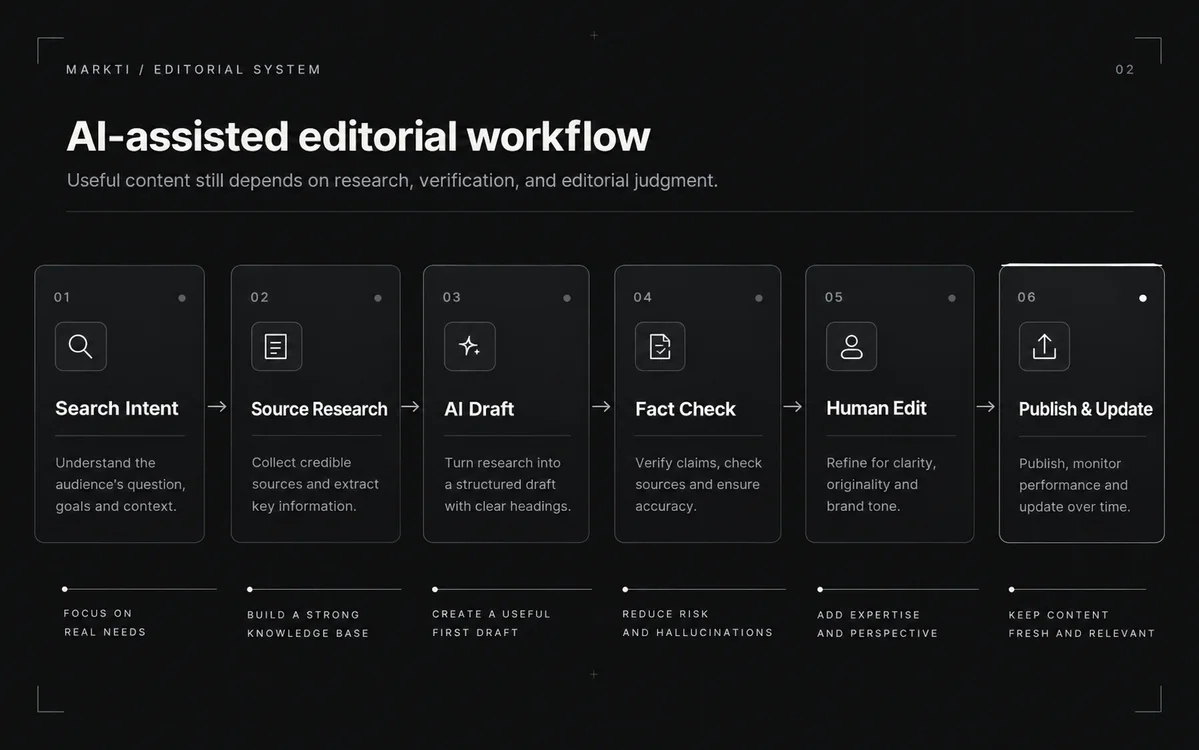
Assign clear roles before creating more content. A strategist or subject expert owns the search question and outline. A researcher gathers sources. AI can assist with grouping evidence, drafting sections, or proposing visual explanations. An editor checks accuracy, usefulness, consistency, and tone before the page is approved.
Start by writing a content brief that includes the target reader, primary question, related questions, actual service relevance, trusted source links, and forbidden claims. Add clear instructions about brand voice. A prompt that says only “write an SEO article” is unlikely to produce a distinctive result.
Prepare the draft in sections instead of asking for a single long article and publishing it without revision. Review the direct answer, each main heading, and every example. Ask what is missing rather than simply requesting more words. Use the reviewer to identify where a diagram would clarify a process or a table would simplify a comparison.
Keep a record of revisions. Save the brief, source list, approval decision, and update date in your editorial workflow. If platform guidance changes later, a well-organized article is easier to audit and refresh.
Disclose meaningful use of automation where readers would reasonably benefit from knowing how the content was produced. More importantly, ensure a person is accountable for the final claims and content quality.
How can you measure whether the article is working?
Check technical access first. Can search engines crawl the page? Is it indexed? Does the correct canonical URL appear? Are images and structured data accessible? Technical failures can prevent a useful article from being discovered, so confirm these basics before changing the copy.
Next, evaluate whether the page reaches the intended audience. Google Search Console can help show which queries and pages receive search impressions and clicks. Look for a mismatch between the question people search and the answer the page gives. Do not judge a new page only by its first few days of data.
Measure what readers do next where privacy-compliant analytics are available. Do they visit a related article, explore a service page, or submit a relevant inquiry? A highly visited article with no clear next step may need better internal navigation rather than more keywords.
Example: An SEO article about AI content may attract people researching content policies. It can naturally link to Markti’s SEO service or related guidance. The link should be helpful and contextually relevant, not an unrelated aggressive sales pitch.
Set a review schedule and record what was changed: title, examples, links, visuals, or facts. If the page attracts the wrong queries, reconsider the angle. If visitors arrive but leave with unanswered questions, expand the practical explanation. Useful measurement connects search visibility with reader satisfaction and business relevance.
Frequently asked questions
Can Google detect AI-written articles?
Search systems may evaluate many patterns and signals, but writing tools are not the main quality test to optimize for. Focus on whether the page is accurate, helpful, original in its contribution, and built to serve readers rather than manipulate search results.
Should I publish AI drafts without editing?
No. Check facts, usefulness, brand voice, sources, and examples before publication. Human review is especially important for medical, financial, and other sensitive claims. A polished draft can still contain unsupported or misleading statements.
How many keywords should one AI-assisted article target?
Choose one main search intent and a small group of genuinely related questions. Include natural language in headings and body copy. Avoid writing multiple thin articles for nearly identical keyword variations when one thorough page answers them better.
Does longer AI content rank better?
Word count alone does not make a page useful or guarantee rankings. Write enough to answer the question well, with clear structure and specific examples. Remove repetition even if it reduces the length, and keep the page easy to use on mobile.
What to do before publishing your next article
Choose one meaningful customer question, collect reliable sources, build an outline, and use AI only where it saves repetitive work. Review the finished draft for facts, originality, clarity, and a useful next step. Keep the page current as customer questions and platform guidance change.
- Write for the reader’s purpose before thinking about rankings.
- Verify every significant claim and statistical reference.
- Add actual expertise and specific explanations.
- Keep a human editor responsible for the final page.
Related: where AI reduces marketing work and Markti’s AI marketing approach.